Sport has played an incredibly important role in the day-to-day lives of those serving in the army for centuries. Starting as informal matches arranged within individual corps and regiments, and expanding into the more professional organisation of teams and tournaments that are more recognisable today, sports in the army has a rich history that deserves to be explored in-depth.
This online exhibition highlights the sporting history of the AGC and its antecedent corps, telling it through a range of objects, from trophies, to medals, and even an Olympic Games uniform! Read on to explore a curated selection from this fascinating part of our history.
Pre 1900s
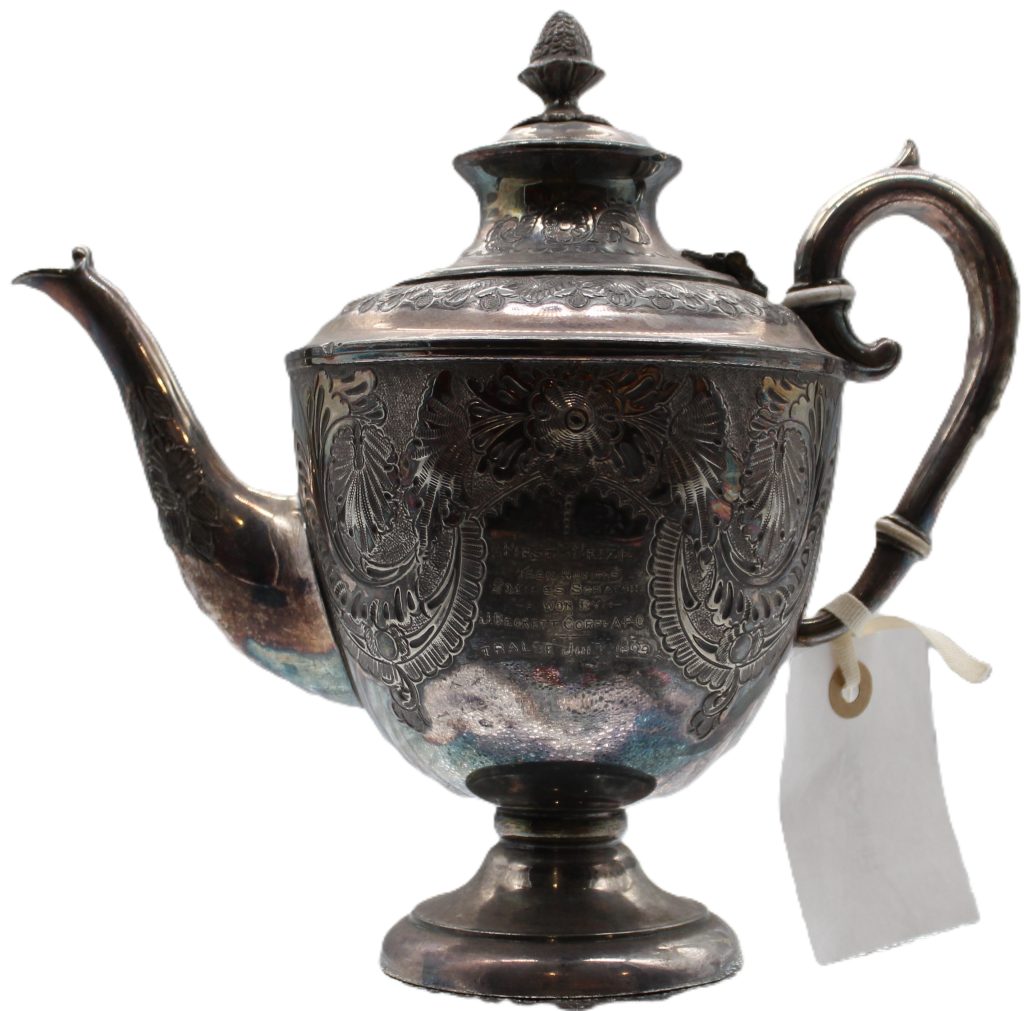
Engraved Trophy, ‘First Place Open Novices 2 Miles Scratch Won by J. Beckett Corpl. APC Tralee July 1899’
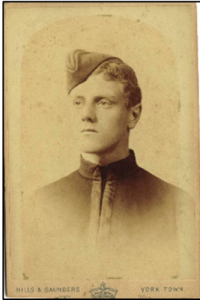
The above is an engraved trophy won by, then, Corporal Joseph Beckett of the Army Pay Corps whilst he was stationed at Ballymullen Barracks, Tralee, in County Kerry, Ireland. We believe a 2 Miles Scratch is a track & field running race, where all participants begin from the same line.
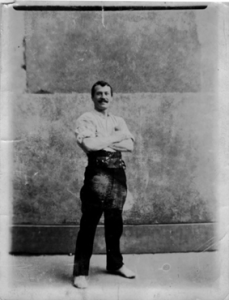
Joseph Beckett would go on to have quite the career. In 1911 he was a Quartermaster Sergeant in the APC, and by 1917 he was a Senior Quartermaster, Acting Sergeant Major. For his actions during the First World War he was awarded the Meritorious Service Medal in February 1917.
Corporal Joseph Beckett
One of the most popular sports amongst the Army, pre-1900, was Polo. The origins of Polo can be dated back to the 6th Century BCE, however it would not reach England until 1834, with the first game of Polo being played on British soil occurring in 1869. Ireland would follow the year after, in 1870. It would become an instant success with the military, and officers soon began spreading it across the British Empire.
Although we do not hold many records detailing the inclusion of our antecedents in Polo games pre-1900, it is likely that they participated in regimental games held at individual barracks and military colleges.
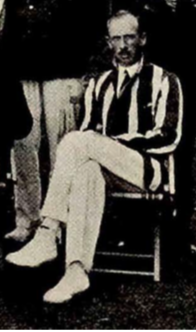
Second Lieutenant John Cecil Armstrong of the Royal Inniskilling Fusiliers made up part of the Regiment’s polo team in 1893, in which they won a Polo tournament held in London. Armstrong was quite the sporting man, also participating in the Regiment’s cricket team, from which he would sustain an eye injury that ended his sports career.
In 1898 he transferred to the Army Pay Department as Captain, and saw serving in the Second Anglo-Boer War. He was appointed Staff Paymaster in 1906, and by March 1911 Armstrong was a Lieutenant-Colonel, and would act as Temporary Colonel during the First World War.
John Cecil Armstrong
1900-1970s
The Museum is incredibly lucky to own a large collection of army sports objects and archival materials, once belonging to Colonel Robert Alfred Rusbridge, CBE, MBE, Royal Army Educational Corps (1889-1981).
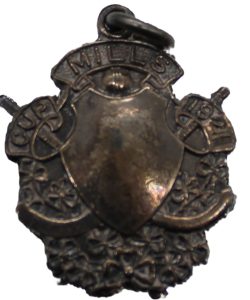
Rusbridge began both his army and sporting careers with the Corps of Army Schoolmasters in the early 1910s. He was a member of the field hockey and tennis teams, and would go on to win the Mills Cup for Field Hockey in the 1910/11 season whilst stationed in Ireland.
In the 1930s, the AEC became heavily involved with the education and development of the Indian Army. This meant that Rusbridge moved over to India with his Corps, although this did not hinder his sporting career. He ran a series of Cricket Tournaments for the Army in India, and he himself had quite the successful year in 1931. He participated in the AEC Hockey and Cricket XI teams, won a Garrison Open Tennis Singles, and won at a Garrison Inter-Unit Golf tournament. That same year he received the Corps Tennis, Hockey, and Cricket Colours.
Following the end of the Second World War, Colonel Rusbridge, now Deputy Director of Army Education, continued his winning streak by placing first at the 1950 Annual RAEC Golf Competition. Having received a MBE in 1936, he would go on to receive a CBE in 1952. Rusbridge’s last game of golf was played at Camberly in 1961 when he was 72.
Across all sports, he received 20 individual caps, some of which can be seen on display in the Museum.
Photographs of Colonel Robert Alfred Rusbridge, CBE, MBE. Bottom shows him at the Royal Hibernian Military School
Mills Cup Hockey Medal, 1921, Presented to Major AJ LeGrys, RHHC
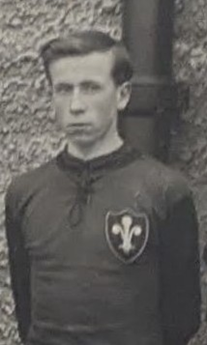
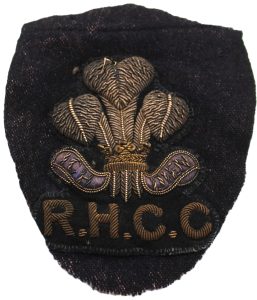
Blazer Badge for Royal Hibernian Military School Hockey Club, featuring Prince of Wales Plume
In 1769 the Royal Hibernian Military School was established in Dublin. The school’s aim was to educate the poor and orphaned children of the British Army in Ireland, by providing them with a basic education, and training them with skills, with the intention that they would later join the army. Boys who didn’t want to join were sent to apprenticeships, and girls were sent into service. An ever increasing part of the boys’ education was the participation in school sports clubs. Hockey was, arguably, the most popular, but there were also clubs for cricket, tennis, football, rugby, swimming, and various other sports.
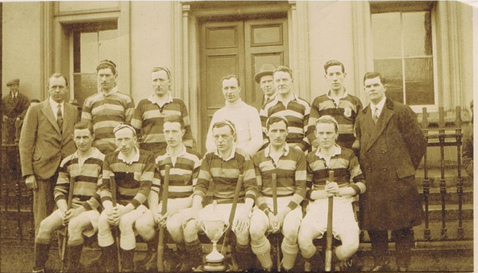
The above left medal belonged to Major Albert James LeGrys, AEC. Le Grys attended the Royal Hibernian Military School and was a member of their Hockey Team between 1919-1921, winning the Mills Cup in 1921. In 1928 he is noted as being a member of the AEC Hockey Team whilst stationed out in Cairo, Egypt. He would later played against the 11th Field Brigade, Royal Artillery, where he would unfortunately lose 1-2 against them in the 1933 Hockey season semi-final.
Royal Hibernian Military School Hockey Club, 1920-21. LeGrys pictured in Back Row, Second Across
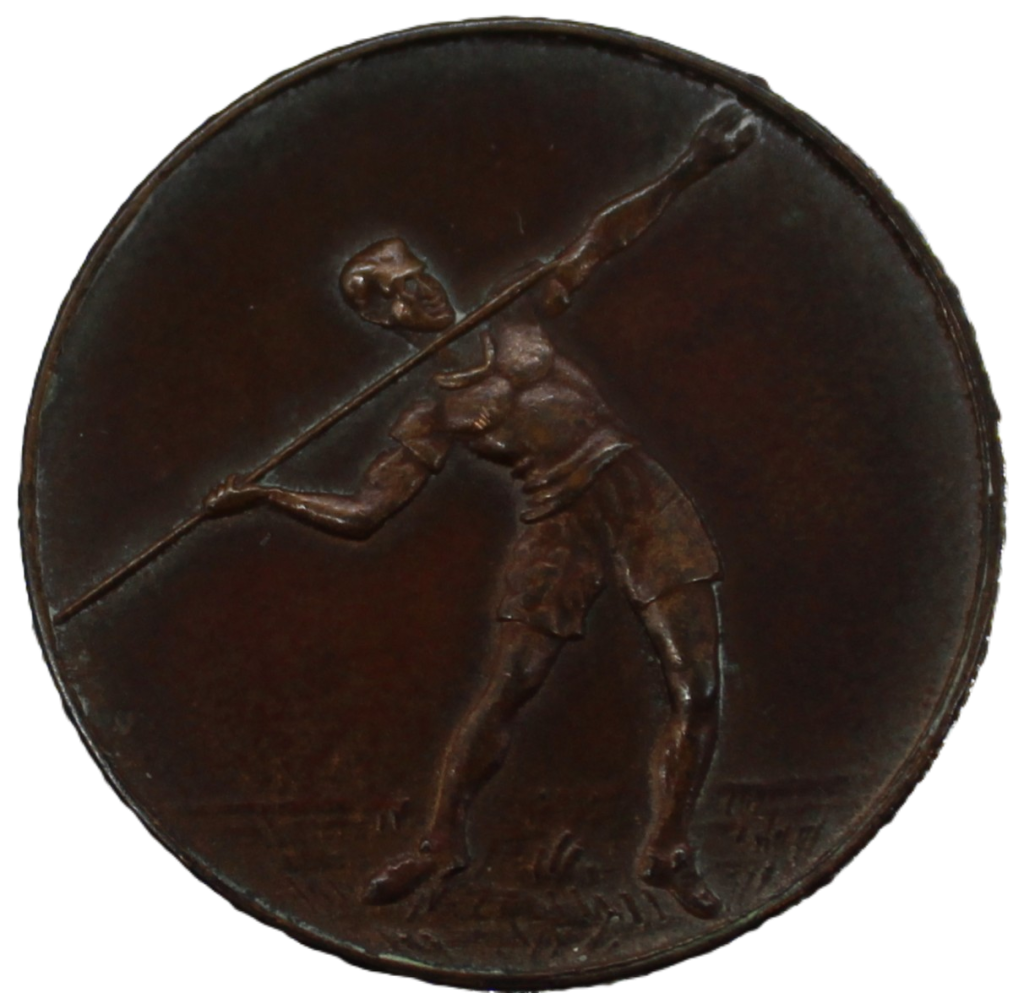
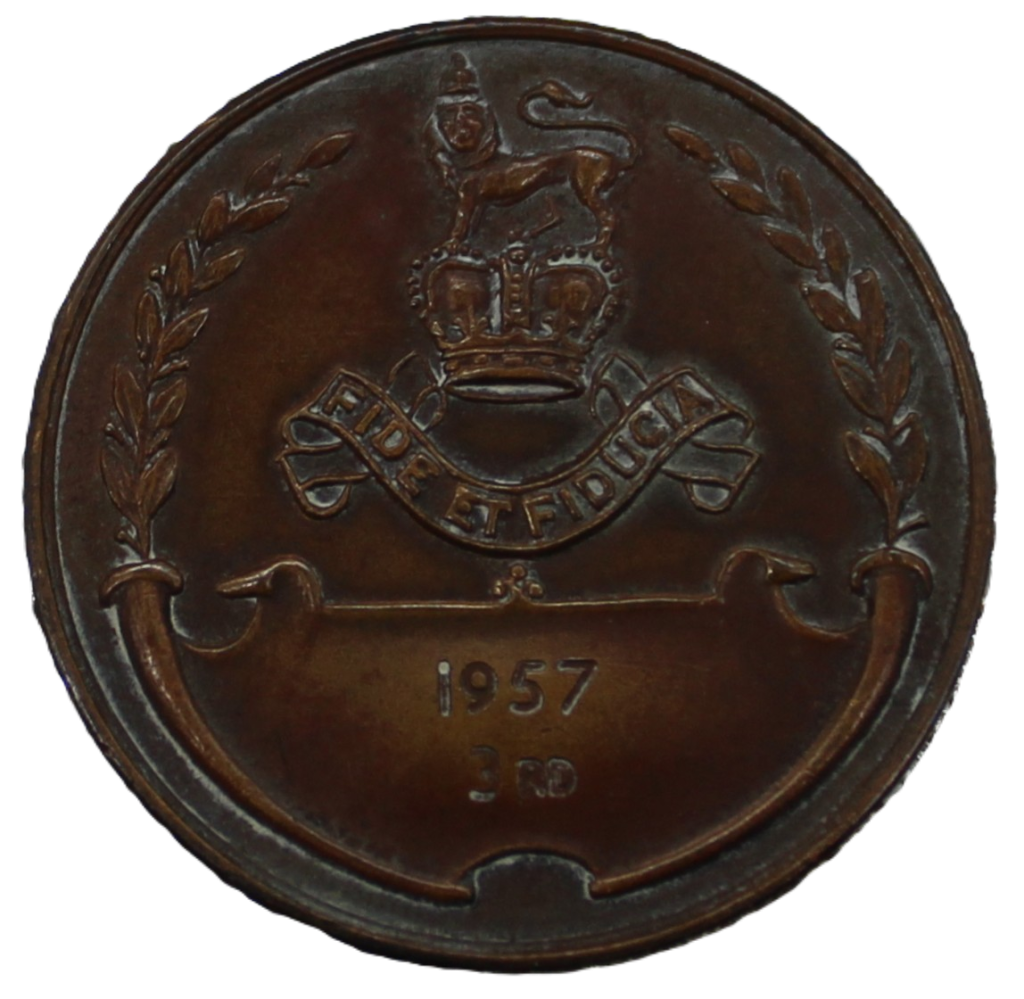
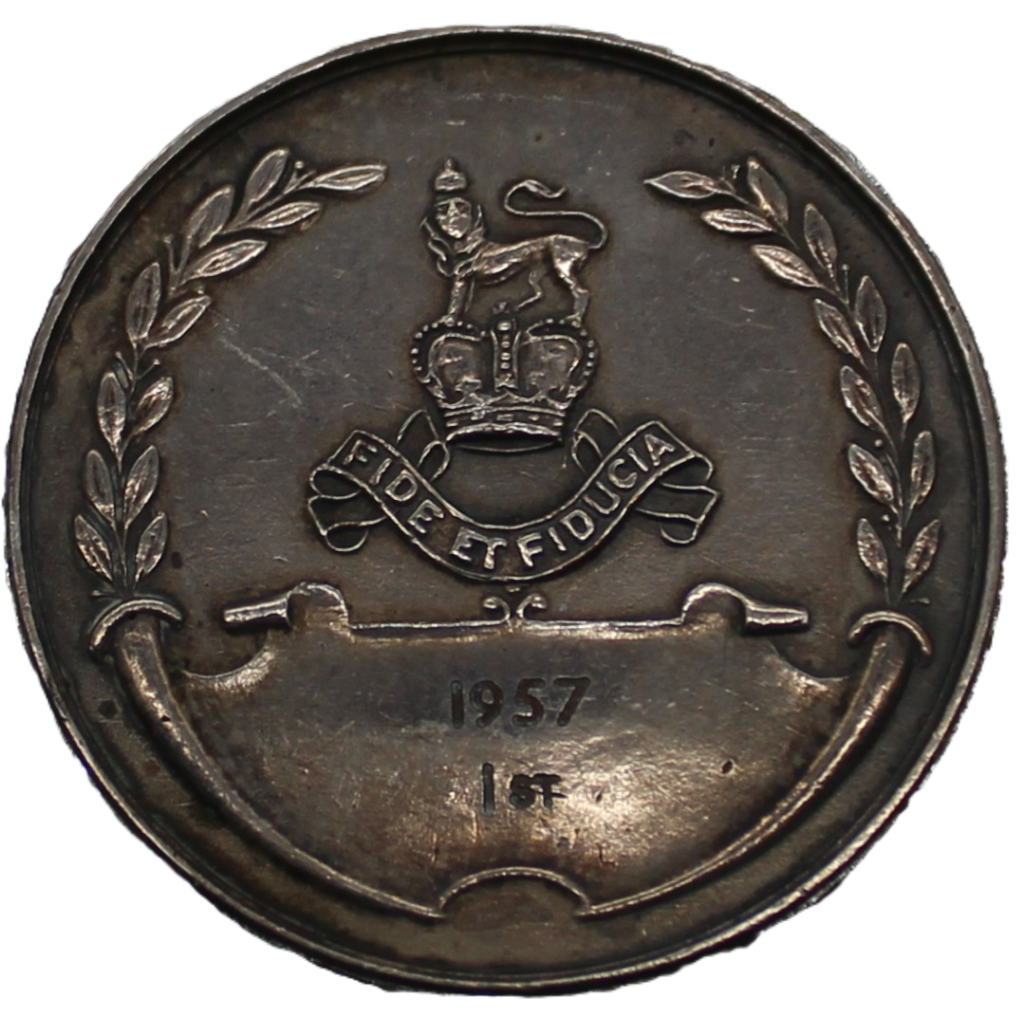
Top Left: 1957 RAPC javelin medal won by L/Cpl Rodney Biggs
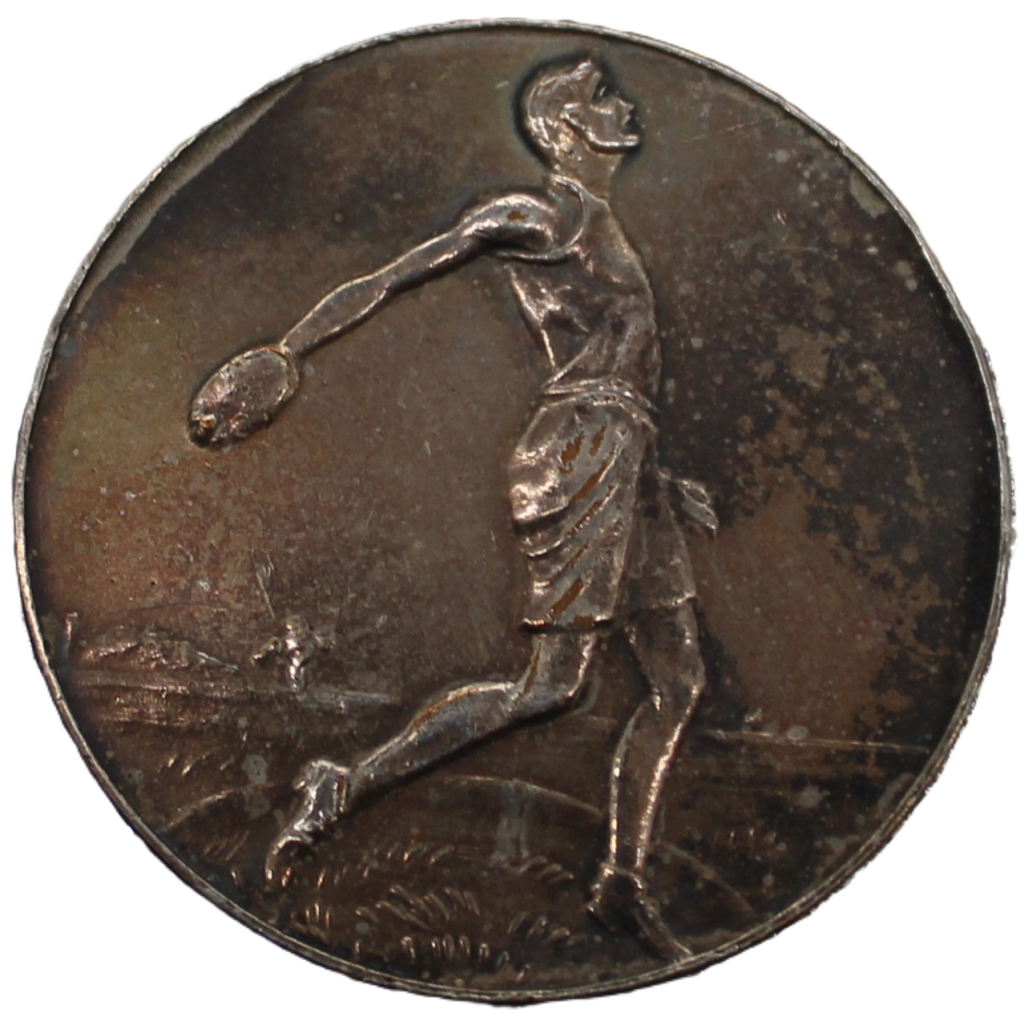
Top Right: 1957 RAPC 1st place discus medal won by L/Cpl Rodney Biggs
Bottom Left: 1957 RAPC Javelin Medal won by L/Cpl Rodney Biggs, reverse
Bottom Right: 1957 RAPC 1st Place Discus Medal won by L/Cpl Rodney Biggs, reverse
The AGC and its antecedents also have links to the Olympic Games. Two members of the Auxiliary Territorial Service participated in the 1948 Summer Olympics, held in London.
Bevis Marie Anael Shergold’s (née Reid) skill as a shot putter, discus, and javelin thrower was first demonstrated at the 1938 Women’s Amateur Athletics Association Championship, when, aged just 19, she won the shot and discus double. That same year she competed at the European Championship, held in Paris, coming 5th in shot put and 8th in discus. Between 1938 and 1952 she won 12 WAAA titles, three of which were at the 1948 championship (1 for discus, shot put, and javelin).
Reid’s athletics career was briefly put on hold following the outbreak of the Second World War, with Reid joining the ATS in 1940. She was one of the first women sent abroad during the war, and is noted for her was a translator for Prisoners of War in Egypt and Algeria.
The war seemingly had no effect on Reid’s athleticism, as she would go on to win eight more titles at the WAAA between 1947-1951 (4 for shot put, 3 for discus, 1 for javelin). She competed at the 1948 Olympics, representing Britain at the shot put, where she placed 8th, and the discus, where she placed 15th.
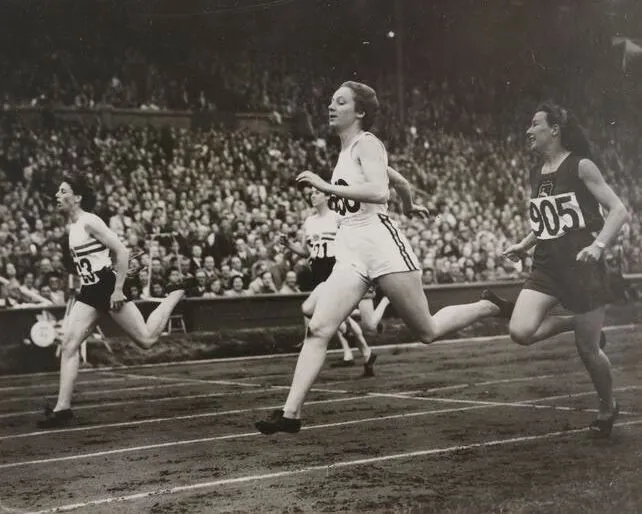
Audrey Williamson (left) coming joint first with Shirley Strickland (middle) at the 1948 Olympics semi-final 200m (image courtesy of The Daily Herald Picture Library at the National Science and Media Museum)
Audrey Williamson was the second ATS member to participate in the 1948 London Olympics. Before the Olympics, Williamson’s sporting career was largely confined to inter-services competitions. She only ran her first competitive race, the 200m, ten weeks before participating in the Olympics. It would also be only 5 weeks before then that she received any kind of official sports coaching.
It was reported that she held good form in the preceding heats, taking joint first in a semi-finals race. However, it was still a major surprise that she finished second, in the Olympics 200 metres, just behind The Netherlands’ Fanny Blankers-Koen. Williamson’s silver medal remains the best performance for a British female athlete at the Olympics.
She continued competing in army competitions and tournaments until 1954, winning many titles, although she did not reach the same heights as in 1948, nor was she chosen for any other championships. She married Major Brian Mitchell in 1958 and retired from service.
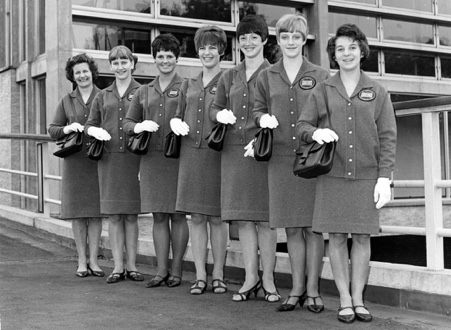
Dortmund World Championships 1966 Women's Gymnastics Team, Corporal Diana Lodge 4th across (Courtesy of gymnasticshistory.co.uk)
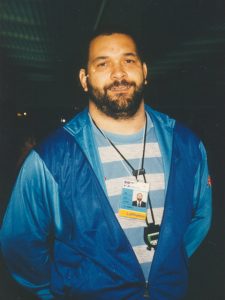
Corporal Arthur Mapp, RAPC
Other Olympic athletes include Corporal Diana Lodge, Women’s Royal Army Corps, who worked as a physical training instructor for 7 years. She competed in gymnastics for Britain at the 1972 Munich Olympics.
Corporal Arthur Mapp, Royal Army Pay Corps (RAPC) also won bronze in Judo in the 1980 Moscow Olympics. He initially lost to the eventual gold medallist (Dietmar Lorenz, East Germany) in the semi-finals, but won the repechage (a second-chance contest) against Dambajavyn Tsend-Ayuush (Mongolia), which secured him the bronze. Mapp went on to become the Great British judo champion in 1981, after winning the British Judo Championships’ Open Division.
1980-Present Day
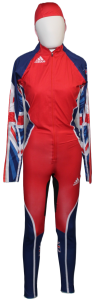
Ski suit for the 2010 Vancouver Winter Olympics, possibly worn by a member of the AGC.
Further sporting success came with Lance Corporal Anne Taylor, WRAC. Taylor was paralysed from the waist down due to a devastating injury during a gymnastics rehearsal. This did not stop her though, as she went on to become an incredibly successful Paralympian. In the lead up to the 1984 Paralympic games in New York, she won 16 gold and 18 silver medals in archery, slalom skiing, pistol shooting, field events, boules, and table tennis at both national and international levels. At the 1984 Paralympics she won 3 bronze medals in 300m, 400m, and 500m in ice sledging.
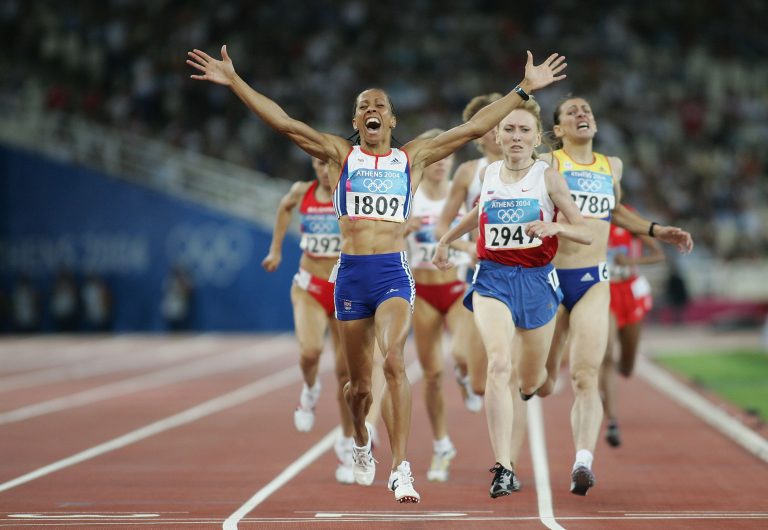
Dame Kelly Holmes at the 2004 Athens Olympics (Courtesy of teamgb.com)
Dame Kelly Holmes, WRAC and later AGC, is perhaps one of the most successful sporting personalities from our corps. She began competing in middle-distance events in the early 1980s before joining the WRAC in 1988. She would transfer into the AGC upon it’s amalgamation in 1992, remaining with the Corps until 1997. Whilst serving, she competed in many of the inter-services athletics events. 1994 saw her first appearance at the Commonwealth Games, winning the 1500m. That same year she won silver at the European Championships for the same race. In 1995 she won a silver and bronze medal at the Gothenburg World Championships, and in 1996 she competed at the Atlanta Olympics, although did not win any medals.
Holmes’s first Olympic medal came at the 2000 Sydney Olympics, where she won bronze in the 800m. She again won the 1500m at the 2002 Commonwealth Games, and the 800m bronze at the Munich European Championships. Her final major championship occured in 2004, when she won two gold medals at the Athens Olympics; the 800m and 1500m. In 2005 she was appointed Dame Commander of the Order of the British Empire (DME), and retired from athletics.
From 2018-2024 she was an honorary colonel in the Royal Armoured Corps Training Regiment (RACTR). She also has a career as a motivational speaker, author, and television personality.